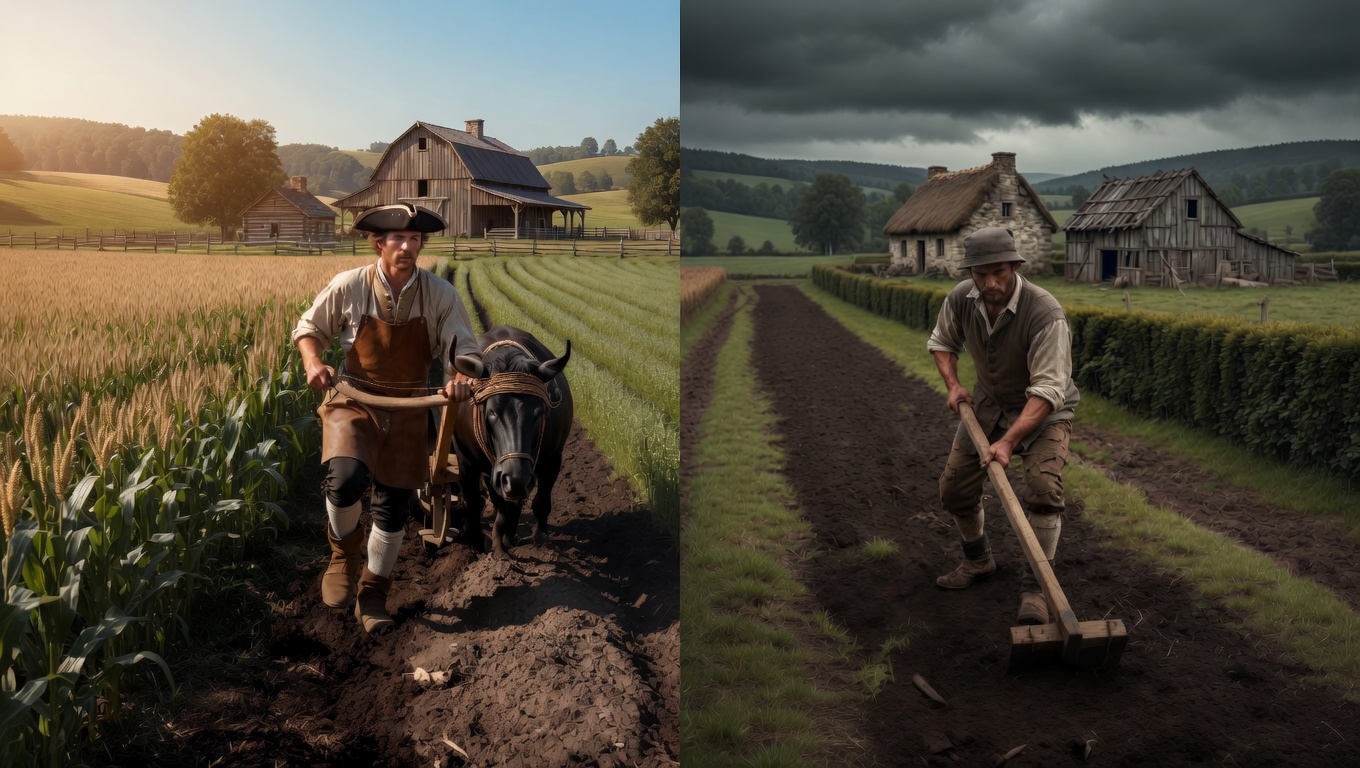
A Colonial Farmer vs. an English Farmer in 1750: Two Worlds, One Plow
In 1750, two men woke before sunrise to tend their land. One stood on a hillside farm in Devon, England. The other stood at the edge of a clearing in colonial Virginia. Both were farmers. Both worked from dawn to dark. Both prayed for good weather and feared a bad harvest. But the world each man inhabited — the rules, the rhythms, the possibilities, and the limits — could hardly have been more different.
This is the story of those two men. Not specific individuals, but composites drawn from the historical record: the kinds of farmers who actually existed on both sides of the Atlantic in the mid-eighteenth century. Their parallel lives reveal something essential about why the American colonies developed the way they did — and why, by 1776, so many colonists were willing to fight for a different kind of world.
The Land Beneath Their Feet
Begin with the most fundamental difference: land itself.
In England in 1750, agricultural land had been claimed, divided, and worked for centuries. The landscape was a patchwork of enclosed fields, common grazing lands, and ancient manors owned by a small aristocracy. A tenant farmer in Devon — which is where we’ll place our English farmer, a man we’ll call Thomas — likely worked land he did not own and could never own. He rented from a landlord, paid in cash or a share of his crop, and held his tenancy at the landlord’s pleasure. If the landlord decided to enclose the common fields, as many were doing in this era, Thomas might find himself suddenly landless.
Across the Atlantic, the situation was almost incomprehensibly different. Our colonial farmer — call him William, living in the Virginia piedmont — almost certainly owned his land outright. Not rented. Not borrowed. His. Colonial land was cheap, abundant, and actively distributed by colonial governments eager to develop the interior. A man of modest means could acquire fifty to two hundred acres through headright grants, land patents, or straightforward purchase at prices that would have seemed fantastical to any English tenant farmer.
This single difference — owned land versus rented land — shaped everything else about their lives.
Thomas in Devon farmed perhaps thirty to fifty acres, constrained by what he could afford to rent and what the local land market offered. William in Virginia might work a hundred acres or more, with the possibility of acquiring additional land as his circumstances improved. The historian Bernard Bailyn, in his landmark study of Atlantic migration, observed that the promise of land ownership was the single most powerful force drawing English men and women to the colonies throughout the seventeenth and eighteenth centuries. It was not abstract freedom they sought — it was acres.
A Day’s Work
Both men rose before dawn. In this, their lives were identical.
Thomas began his day tending livestock — likely a small dairy herd, some pigs, and chickens. Devon agriculture in 1750 was mixed farming: a combination of livestock raising and grain cultivation, with a heavy emphasis on dairy. He would have milked cows, mucked out stalls, and fed animals before turning to field work. His fields were worked in rotation — a three-field system that had governed English agriculture since the medieval period, leaving one field fallow each year to recover its fertility.
William’s morning looked similar in its broad outline but different in almost every particular. His livestock were fewer — a ox or two for plowing, some hogs turned loose in the woods to forage, chickens scratching around the dooryard. His primary crop was not grain or dairy but tobacco: the great cash crop of the Virginia tidewater and piedmont, the commodity that connected his small farm to merchants in London and Bristol and gave him access to the Atlantic economy.
Tobacco farming was grueling, labor-intensive work unlike anything practiced in England. Seeds were started in seedbeds in late winter, transplanted by hand in spring, then tended through a long growing season that required constant attention: topping the plants to redirect energy to the leaves, removing hornworm caterpillars by hand, suckering the side shoots that would diminish leaf quality. Come harvest in late summer, the leaves were cut, hung in tobacco barns to cure through the autumn, then packed into enormous hogshead barrels for shipment.
Thomas worked hard. William worked harder — or at least differently. The tobacco calendar was relentless in a way that English mixed farming was not.
What They Ate
Food is where the contrast becomes most vivid — and most surprising.
Thomas, our Devon tenant farmer, ate a diet that was adequate but narrow. Bread was the foundation — dark, dense loaves of wheat or rye, baked weekly. He had access to dairy: butter, cheese, perhaps some milk. Pork was the most common meat, preserved through salting. Root vegetables — turnips, parsnips, onions — filled out the winter diet. Fresh meat was a luxury reserved for slaughter season or special occasions. A tenant farmer of middling means in 1750 England ate well enough to survive and work, but the variety and abundance that marked prosperous eating were largely beyond his reach.
William’s table, by contrast, was often strikingly abundant — at least by the standards of the day. The Virginia forests teemed with game: white-tailed deer, wild turkey, passenger pigeons in quantities that English visitors found almost impossible to believe. The rivers ran with fish. His kitchen garden likely produced corn, beans, and squash in the Native American tradition — crops that had been adopted wholesale by colonial farmers because they grew prolifically in American soil with relatively little labor. Pork was common here too, as hogs were easy to raise in woodland conditions.
This is not to romanticize colonial farm life, which was hard and often precarious. Crop failures happened. Frontier farms in newer settlements faced genuine subsistence hardship. But the broad pattern holds: a middling colonial farmer in 1750 Virginia typically ate more meat, more variety, and more calories than his English counterpart. European visitors noted this repeatedly with something between admiration and bewilderment.
Their Houses
Thomas lived in a farmhouse that had probably stood for generations — stone or timber-framed, low-ceilinged, with small windows that kept out the cold and the light in roughly equal measure. Devon farmhouses of this era were durable and dark. The main room combined kitchen, dining, and living space. The family slept above, in chambers reached by a steep stair. It was not comfortable by modern standards, but it was solid, permanent, and embedded in a landscape that had been humanized for centuries.
William almost certainly built his own house, or his father did. Colonial farmhouses of the Virginia piedmont in 1750 were typically modest wooden structures — hewn timber or plank construction, one or two rooms, a large central chimney that served multiple fireplaces. They were often smaller and less finished than comparable English houses, because labor was scarce and expensive in the colonies, and a farmer’s time was better spent on crops than carpentry. What they lacked in refinement, they sometimes made up for in space: a colonial farmer often had more land around his house, more room, more sky.
The permanence was different too. Thomas’s house was ancient. William’s was new — perhaps built within living memory. The colonial landscape in 1750 was still being made, still raw at the edges, still loud with the sound of axes clearing forest. This newness was exhilarating to some and deeply unsettling to others. There were no cathedrals, no ancient parish churches, no ruins that reminded a man of all the generations who had lived and died before him. The past in Virginia was thin.
Law, Status, and What They Owed
Here the differences cut deepest.
Thomas existed within a dense web of obligations. He owed rent to his landlord — typically paid quarterly, a fixed sum that was due regardless of whether the harvest had been good or bad. He owed tithes to the Church of England, a tax of roughly one-tenth of his agricultural produce. He was subject to the Poor Laws, which regulated where he could live and work. He had few legal protections against a landlord who wished to raise his rent or terminate his tenancy. His social position was fixed not just by wealth but by birth: a tenant farmer’s son was a tenant farmer, and the routes out of that condition were narrow.
William owed far less to far fewer people. He paid taxes to the colonial government — lower, as a rule, than English taxes — and he had no landlord. His relationship with the Church of England, established in Virginia as in England, was looser and less coercive in practice. Most importantly, he voted. Property-owning white men in colonial Virginia participated in elections for the House of Burgesses, the colonial legislature. This was not democracy as we would recognize it, but it was a form of political participation entirely unavailable to a tenant farmer in Devon.
The political philosopher J.G.A. Pocock and others have written extensively about how the classical concept of civic virtue — the idea that true political freedom required economic independence — shaped colonial American self-understanding. William, who owned his land and owed no man his livelihood, was in this tradition a free man in a way that Thomas, bound by tenancy and tithes, was not. This was not mere ideology. It was a material reality that shaped how colonial farmers thought about themselves, their rights, and eventually their relationship to the British Crown.
What They Feared
Both men feared weather, disease, and debt. These fears were universal.
But their specific anxieties diverged in telling ways.
Thomas feared enclosure — the consolidation of common and open fields into privately owned, fenced land that was transforming the English countryside throughout the eighteenth century. Enclosure could eliminate the common grazing rights that supplemented a tenant’s income and made marginal farming viable. It was a slow, legal dispossession, and it was happening all around him.
William feared different things: a bad tobacco market, which could wipe out a year’s work with a stroke of a merchant’s pen in London. He feared the violence of the colonial frontier, still a living reality in 1750 as French and British interests collided in the Ohio Valley and war with Native American nations remained a constant threat in newer settlements. And he feared debt — not the abstract debt of rent, but the deep, structural indebtedness to British tobacco merchants that ensnared many Virginia planters, large and small. By the mid-eighteenth century, Virginia’s planter class was chronically in debt to London and Bristol merchants who bought their tobacco, and that indebtedness would become a powerful grievance in the years leading to revolution.
The World Their Children Would Inherit
Thomas’s son, in all likelihood, would be a tenant farmer too. The English agricultural system in 1750 was not without mobility — some men rose, some fell — but the broad structures of tenancy, class, and land ownership were stable and self-perpetuating. A Devon farm boy who wanted a different life had real but limited options: apprenticeship in a trade, migration to a city, or emigration to the colonies.
William’s son faced a genuinely open horizon. He could inherit his father’s land. He could acquire new land to the west, where the frontier was always moving. He could enter trade, law, or medicine with fewer of the class-based barriers that governed English professional life. He could — as increasing numbers of colonial men were doing — begin to think of himself not as a British subject living temporarily in America, but as something new: an American.
That identity was still forming in 1750. It would crystallize, violently, in the decade that followed.
Two Worlds, One Plow
The plow was the same. The seed went into the same kind of earth. The sun rose on both men at the same moment, on opposite sides of an ocean they might never cross.
But the world those two farmers inhabited — the legal world, the social world, the world of possibility and obligation — was profoundly different. William owned what Thomas could only rent. William voted where Thomas had no voice. William ate more, owed less, and could imagine his children doing better than he had done. Thomas worked within a system that had been in place for centuries and showed no sign of yielding.
When the crisis of the 1760s and 1770s came — when the British Crown began asserting new taxes and new controls over its colonial subjects — it was men like William who resisted most fiercely. Not because they were oppressed, but precisely because they were not. They had tasted genuine independence, genuine ownership, genuine political participation. The idea of surrendering any of it to a distant Parliament in which they had no representation was not merely politically objectionable.
It was, to a man who owned his land and answered to no landlord, almost incomprehensible.
Further Reading
These books informed this article and are essential reading for anyone who wants to understand colonial and early modern Atlantic history in depth.
- Albion’s Seed: Four British Folkways in America — David Hackett Fischer
The definitive study of how British regional cultures transplanted themselves to America. Fischer’s treatment of Virginian settlers from the English gentry tradition is essential context for understanding the colonial farmer’s world. - The Peopling of British North America — Bernard Bailyn
A short, brilliant introduction to the forces — land hunger above all — that drove Atlantic migration in the seventeenth and eighteenth centuries. - Tobacco Culture: The Mentality of the Great Tidewater Planters on the Eve of Revolution — T.H. Breen
Breen’s examination of how tobacco economics shaped Virginia planter identity and grievance is indispensable. Even small farmers were touched by the tobacco system he describes. - The English Farmhouse and Cottage — M.W. Barley
A thorough survey of English vernacular architecture that brings the physical world of the English tenant farmer to life. - Everyday Life in Early America — David Freeman Hawke
Accessible and vivid, Hawke reconstructs the material life of colonial Americans — food, housing, work, and play — with authority and readability. An excellent starting point.
AtlanticParallels.com explores history through the lens of parallel lives — ordinary people living through the same era on both sides of the Atlantic. If you found this article useful, share it with a history enthusiast you know, and follow us on X at @AtlcParallels for daily historical parallels.